Download dr java on mac. Java 5 compatibility has been dropped. To use DrJava, you will need Java 6 or newer. New features since the last stable release: - DrJava is now compatible with Java 8 and perhaps with future editions of Java. Bug fixes since the last stable release: - DrJava correctly finds and labels Oracle JDK 7 compilers on Mac. Windows Appi Mac OS X App Current Eclipse Plug-in. The current version of the DrJava Plug-in for Eclipse is drjava-eclipse-20090115-r4708, which is very old. It only works with versions of Eclipse from the same era (a decade ago). For information about how to download and use the plug-in, see our Eclipse Plug-in page. Monitor Releases. Download DrJava 20140826 r5761 for Mac from FileHorse. 100% Safe and Secure DrJava is a lightweight development environment for writing Java programs.
Installed Java 7 on Mac OS X but Terminal is still using version 6 0 when opening eclipse gives “Error: could not open `C:Program FilesJavajre6libamd64jvm.cfg'”. Download Mac OS mojave 10.14 – ISORIVER Finder Quick Actions- This is a useful feature that will allow users to create a PDF or rotate an image without the use of an app. The user can explore the kind of actions that they can perform by checking out the Quick Actions menu. Java: Installing JDK on Mac using Homebrew Published: October 14, 2018 - 1 min read Homebrew is a package manager that makes it easy for us to install all sorts of development tools such as MySQL, Mongo, Ruby on Rails, and Java. Java 1.5.0 free download - Apple Java for OS X 10.6, Apple Java for OS X 10.7/10.8, Java 2 SE, and many more programs. How to: Fix Java Command-Line Tool Pop-Up on Mac OS Truong Nguyen August 29, 2017 How-To After upgrading to a newer version of Mac OS X (Yosemite 10.10 and El Capitan 10.11) or macOS (Sierra 10.12 and High Sierra 10.13), you may end up getting an annoying new pop-up message whenever you start your computer.
U torrents.com free download for mac. See JDK 7 and JRE 7 Installation Guide for general information about installing JDK 7 and JRE 7.
See the Mac OS X Platform Install FAQ for general information about installing JRE 7 on Mac OS X.
Contents
System Requirements
- Any Intel-based Mac running Mac OS X 10.7.3 (Lion) or later.
- Administrator privileges.
Note that installing the JRE on a Mac is performed on a system wide basis, for all users, and administrator privileges are required. You cannot install Java for a single user.
Only one JRE can be installed at a time. The system will not install a JRE that has a lower version than the current version. If you wish to install a lower version of the JRE, first uninstall the current version. Installing a JRE from Oracle will not update java -version symlinks or add java to your path. To be able to do this, you need to install the JDK.JRE 7 Installation Instructions
The JRE installation includes the JavaFX Runtime which is incorporated into the same directory structure.
Installation of the 64-bit JRE on Mac Platforms
Depending on your processor, the downloaded file has one of the following names:
- jre-7u<version>-macosx-amd64.dmg
- jre-7u<version>-macosx-x64.dmg
Where <version> is 6 or later.
1. Download the file. Before the file can be downloaded, you must accept the license agreement.
2. From either the Downloads window of the browser, or from the file browser, double click the .dmg file to launch it.
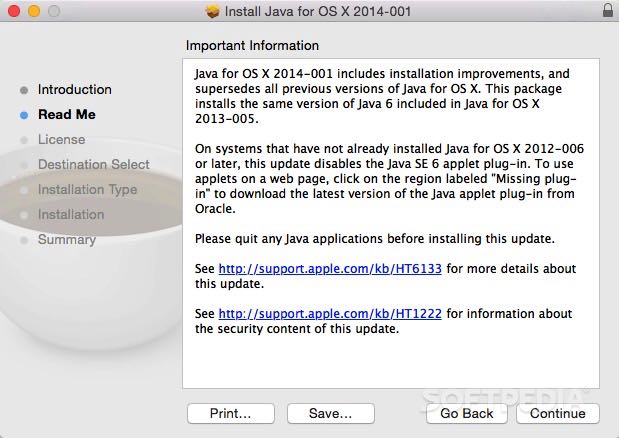
3. A Finder window appears containing an icon of an open box and the name of the .pkg file Double click the package icon to launch the Install app.
4. The Install app displays the Introduction window. Click Continue.
4a. Note that, in some cases, a Destination Select window appears. This is a bug, as there is only one option available. If you see this window, select Install for all users of this computer to enable the continue button. Click Continue.
5. The Installation Type window appears. Click Install.
6. A window appears which says 'Installer is trying to install new software. Type your password to allow this.' Enter the Administrator login and password and click Install Software.
7. The software is installed and a confirmation window appears.
After the software is installed, delete the dmg file if you want to save disk space.
Determining the Installed Version of the JRE
If you have not yet installed Apple's Java Mac OS X 2012-006 update, then you are still using a version of Apple Java 6 that includes the plug-in and the Java Preferences app. See Note for Users of Macs that Include Apple Java 6 Plug-in.Only one JRE can be installed. Installing a JRE removes the previously installed JRE. The JRE version used by the system can be determined in one of two ways:
- From System Preferences click the Java icon from the Other category. This launches the Java Control Panel. Click About...
- Type the following in a Terminal window:
The system will not install a JRE that has a lower version than the current version. If you want to install a lower version, first uninstall the existing version.
Uninstalling the JRE
To uninstall the JRE, you must have Administrator privileges and execute the remove commands either as root or by using the sudo(8) tool.
Remove one directory and one file (a symlink), as follows:
- Navigate to /Library/Internet Plug-Ins and remove the JavaAppletPlugin.plugin directory.
- Navigate to /Library/PreferencePanes and remove JavaControlPanel.prefpane.
Do not attempt to uninstall Java by removing the Java tools from /usr/bin. This directory is part of the system software and any changes will be reset by Apple the next time you perform an update of the OS.
On this page:
Before You Begin
- Mac OS X 10.8 or higher
- Ensure that you have Administrator privileges on the system.
- Ensure that you have 350 MB free on your computer's hard drive.
- If you are logged into SAPgui, log off and 'Quit' the SAPgui application.
- If you have an SAP folder on your hard drive within the Applications folder, make a note of the name of the folder. You will be able to revert to the prior version if necessary.
Pre-Installation Instructions
A. SAPgui and Kerberos Tickets
Acquire Kerberos tickets. Tickets are required to connect to SAP systems
Xmage Github
- SAPgui may bring up the Ticket Viewer to prompt you to obtain Kerberos tickets. If not:
- You may see an error mentioning 'GSS-API'
- SAPgui may stall at 'Connecting..'
- Your SAPgui session may freeze.
All of these behaviors mean that either you do not have Kerberos tickets, or your Kerberos tickets have expired. To resolve that issue, use the instruction below to get tickets manually.
- How to get Kerberos tickets manually
- Launch Kerberos Ticket Viewer (/Applications/Utilities/Ticket Viewer). On Mac OS Catalina it is located in (/System/Library/CoreServices/Applications)
- Enter your Kerberos username (the first part of your @mit.edu email address), and your Kerberos password (the password used to check your @mit.edu email).
- If You cannot find the Ticket Viewer app (Catalina OS) then (re)install the Java JDK, reboot and it should show up.
NOTE: Your Kerberos tickets will last for 10 hours only, and have to be manually renewed if you wish to remain in SAP longer. If you do wish to remain in SAP longer than 10 hours, it's a good idea to renew them at least 20 minutes or so before they expire.
B. Ensure Kerberos Extras is installed
Xmage Card Image Download
Mac os 10.5.0 free download. Download and install Kerberos Extras.
C. Install Oracle Java 8 JDK
Note: SAPgui 7.40 for Mac requires Oracle Java 8 JDK. Go to Oracle's download page to download Java SE Development Kit 8 for Mac OS X. An Oracle account is required to download Java 8 JDK.You'll receive the prompt to create an account once you select the correct JDK version.
- Double-click on the JDK Installer package.
Result: The installer opens. - Click Continue to begin the Oracle Java JDK installer.
Result: The Destination Select window opens. - To install for all users of the computer, click Continue.
Result: The Installation Type window opens. - For a standard install, click Install.
Result: You are prompted for your administrator password. - Enter the administrator credentials and click Install Software.
- The installation will execute.
- Once installation is complete, click Close to finish the installation.
SAPGUI 7.40 rev 2 Installation Instructions
Follow the on-screen instructions and accept all default values to complete the install.
- Download the SAPgui7.40.2 installer
Result: The installer, SAPgui-7.40.2.dmg, should now be in your Downloads folder, or on the Desktop. - Double-click SAPgui-7.40.2.dmg.
Result: The dmg opens and displays the installer. - Click on the installer icon, SAPgui_signed.pkg
Result: The Install SAPgui_signed window appears. - Click Continue.
Result: The Destination Select window appears. - Select your destination, usually your computer's hard drive.
Result: The Installation Type window appears. - For a standard install, click Install.
- When prompted, enter the Administrator password for the computer and click Install Software.
Result: SAPgui will install and show you an Installation Complete message. - Installation is now complete. Click Close.
First Use
- Navigate on your Macintosh Hard Drive to Applications > SAP Clients > SAPGUI > SAPGUI.
- Drag SAPGUI to the dock for easy launch.
- Double-click SAPGUI or click the SAP icon in the dock.
Result: SAP Logon pad launches.
NOTE: If 'Connections' does not have an option for SAP System 'ACP SAP GRC Production', send an email to the Help Desk. - Double-click Production to log in to SAPgui.
NOTE: If the splash screen stalls at 'Connecting..', see SAPgui and Kerberos Tickets. - When connecting for the first time to Production, you may see a pop-up selection box. If it appears, select Productive: Fully Trusted. Needs access to local resources, then click OK. It should look like this:?
If SAPgui remains unresponsive after getting new tickets, you may need to 'Force Quit' the application.
- Follow the menu path Apple > Force Quit.
Result: A popup window appears with a list of applications. - Select SAPGUI.
- Press Force Quit.
- Press Force Quit again to confirm.